
Digital payments · API integration
Virtual Card Autofill for Google Chrome
Owned the technical delivery for the retrieval flow of a major Virtual Card integration with Google Chrome, translating Google's API architecture into an enterprise delivery programme that processed 276,000+ requests in its first 60 days.
- role
- Product Owner — translated architecture to epics, managed backlog, enforced Definition of Done
- timeline
- Launched Nov 2024
- status
- Live in production
My scope
What I owned, what was shared, what I did not touch
- Retrieval flow: epics, user stories and acceptance criteria
- Scoping and delivery of the Retrieval endpoint on the new edge microservice (OCP)
- Definition of Done, with observability shipped in the same story
- Integration with downstream risk, token and DCID systems
- Edge-case triage during Google's integration testing
- Domain boundary with the Enrolment/Unenrolment PO
- Partner commercial relations (account executives)
- Enrolment and unenrolment flows (a peer PO)
Execution graph · click a stage
From the problem to the outcome
Google's 5-second retrieval limit, on the path that fires as the shopper pays.
- Retrieval is the critical path. Tolerance for latency, friction or failure there was zero.
- The integration split into two domains: Enrolment/Unenrolment (generating and unlinking the token) and Retrieval (fetching the tokenised details during a transaction).
The context
Why this integration was hard to deliver
Online checkout has to balance high security against low friction. To solve it, a major US card network partnered with Google to autofill virtual cards directly inside Chrome, so a shopper's real card number never reaches the merchant. For the network, this wasn't just a UX fix — friction at checkout is what loses top-of-wallet usage to a competing card.
Google defined the overarching solution and API framework (Virtual Cards v1), but the reality of enterprise software is that execution is where integrations actually succeed or fail. Translating Google's strict cloud requirements into the network's highly regulated, legacy backend architecture was where the real delivery risk lived: there was nowhere in the existing estate for this to plug into. Delivery meant standing up a new microservice (the edge component for all inbound Google traffic into the network, spanning enrolment, unenrolment, retrieval, and sendOTP), hosted on OpenShift (OCP).
My scope
My scope in detail
- Broke down dense enterprise architecture flows into structured epics and rigorously defined user stories.
- Scoped and drove delivery of the Retrieval endpoint on a new microservice — the edge component for all inbound Google traffic into the network (enrolment, unenrolment, retrieval, sendOTP) — hosted on OpenShift (OCP), since nothing in the existing estate could serve it.
- Mapped and mitigated complex failure scenarios (e.g. network timeouts) to ensure graceful UI fallbacks.
- Partnered deeply with the Enrolment/Unenrolment-flow PO to keep domain boundaries clean and state management consistent.
- Integrated the Retrieval flow within the edge application against downstream systems — to get the risk decision on the retrieval request, and to fetch the token and DCID cryptogram details.
- Communicated directly with Google stakeholders during high-stakes integration testing to triage edge cases.
- Every story had to clear the full pre-prod test suite, meet every acceptance criterion, and deploy to production before it counted as Done — no partial credit.
- Any new functionality shipped with matching observability — new monitors or dashboard widgets — in the same story, never backfilled later.
- Every functional story was scoped as a vertical slice that could be productionized independently.
- Overarching partner commercial relations (owned by account executives).
- Enrolment/unenrolment flows (owned by a peer PO).
The technical puzzle
Two engineering problems under one flow
The retrieval flow isn't just about passing a static number — it's about real-time security. Instead of the user's real card number, Chrome autofills a token plus a DCID: a dynamic, one-time equivalent of a physical card's CVV, generated fresh per transaction and dead the moment payment settles. Even intercepted mid-transaction, it's already useless.
Getting the cryptography right — managing real-time latency, error handling, and payload security on every single checkout — was a massive engineering puzzle. It's unglamorous infrastructure, but when built right, it just works and nobody notices.
How I worked it
Four practices that carried it
- 1
Transcribed the spec into epics, sequenced by release of value
I translated Google's functional flow and API spec directly into epics and user stories — broken down by incremental release of value, not by technical layer: the green flow without risk checks first, then the green flow with risk checks added, then the yellow flow with OTP integration layered in last.
- 2
Coordinated across every team the flow touched, not just my own
Retrieval didn't sit in isolation — it depended on downstream teams for the risk decision, the token, and the DCID cryptogram, ran in parallel with the peer PO owning Enrolment/Unenrolment, and needed direct engagement with Google's own team during integration testing. I owned every story and edge case on Retrieval, but shipping it meant staying aligned across all three fronts at once.
- 3
Held every story to a DoD that didn't stop at "deployed"
A local unit test passing wasn't proof of anything at this scale — nothing left the backlog as Done until it cleared the full pre-prod suite and was verified in production. That same bar covered observability too: if a story shipped new functionality, the monitoring and dashboards for it shipped in the same story, never as a follow-up.
- 4
Validated live before trusting it at scale
There was no user-facing feedback loop on this: real behavior was the only signal that mattered, so validation meant watching it myself rather than waiting on a research or support channel that didn't exist yet. Rollout was phased and tightly controlled: 1% of eligible cardholders first, then 10%, then 100%, and in that first phase only specific Google-whitelisted email addresses could even see the feature. I ran live retrievals myself against a dummy shopping-cart URL Google's own team shared, watching the autofill actually populate and tracing the full flow through Kibana in real time, seeing individual transactions work end to end before the flow was trusted with real volume.
Decision records
Execution calls I made
DECISION 01
Chased the yellow path from 7–8s to inside Google's 5-second limit
Green 2.4s → 1–1.2s. Yellow 7–8s → 3.5–4s.
DECISION 01
Chased the yellow path from 7–8s to inside Google's 5-second limit
Green 2.4s → 1–1.2s. Yellow 7–8s → 3.5–4s.
- Problem
- Performance testing put the yellow path at 7–8s once the real fraud system was in the path, against Google's 5-second NFR.
- Decision
- Traced the latency through Datadog to the fraud system's downstream calls, then worked with that team directly. They optimised their APIs and cut their own downstream call count.
- Why
- On the yellow path the response doesn't carry card details. It tells the user to complete a step-up challenge first, so a 5-second wait before any OTP round-trip had started wasn't acceptable.
- Result
- Green 2.4s → 1–1.2s. Yellow 7–8s → 3.5–4s.
- Not mine
- The fraud system's own APIs and business rules.
Full account from the case study
Performance testing threw a curve ball: Google's own NFR required retrievals to respond within 5 seconds. Green flow was fine at 2.4s, but the yellow flow (now hitting the real fraud system) was taking 7-8s. I worked with the engineers to trace it through Datadog to the fraud system's own downstream calls, then worked with that team directly; they optimized their APIs, cut their own downstream call count, and got green flow to 1-1.2s and yellow flow to 3.5-4s. On the yellow path, that response isn't even the card details: it's Google's instruction that the user needs to complete a step-up challenge first. A 5-second wait just to learn that, before any OTP round-trip has even started, wasn't something I was willing to accept.
DECISION 02
Raised a risk I did not own to the person who did
Became an MVP2 item, delivered by the Enrolment team in Q2 2025.
DECISION 02
Raised a risk I did not own to the person who did
Became an MVP2 item, delivered by the Enrolment team in Q2 2025.
- Problem
- A user re-clicking autofill while waiting would send extra requests, which needed idempotent handling to avoid duplicate processing.
- Decision
- Raised it as an input to the PM rather than deciding it myself.
- Why
- As PO on this initiative, prioritisation sat with the PM.
- Result
- Became an MVP2 item, delivered by the Enrolment team in Q2 2025.
- Not mine
- Prioritising the idempotency fix.
Full account from the case study
Chasing that latency fix surfaced a second-order risk: a user re-clicking autofill while waiting would generate extra requests that needed idempotent handling to avoid duplicate processing. As PO on this initiative, prioritization calls like this sat with the PM, not me — so I raised it as input rather than deciding it myself. It became an MVP2 item, delivered by the Enrolment team in Q2 2025.
DECISION 03
Built a mock fraud signal to keep delivery moving
Integration ran against the mock until the real system was ready.
DECISION 03
Built a mock fraud signal to keep delivery moving
Integration ran against the mock until the real system was ready.
- Problem
- The first release (green flow, no risk checks) had shipped. The fraud team's side wasn't prioritised for the next release.
- Decision
- Built a close approximation of how the fraud team would process Google's risk signals, not their actual business rules. Integration ran against the mock.
- Why
- The alternative was to halt development citing a downstream blocker.
- Result
- Integration ran against the mock until the real system was ready.
- Not mine
- The real fraud rules.
Full account from the case study
Our first release of value was the green flow with no risk checks, since the fraud team's side simply wasn't prioritized yet. For the next release, I had two options: halt development citing a downstream blocker, or keep moving. We worked with the fraud team to understand, at a high level, how they'd tentatively process Google's risk signals (not their actual business rules, just a close approximation) and built a mock from that. Even our integration environment ran against it until the real system was ready.
DECISION 04
Wrote the certification tests myself, because nobody else would
Sandbox and production certification passed with zero functional defects, against cases I wrote.
DECISION 04
Wrote the certification tests myself, because nobody else would
Sandbox and production certification passed with zero functional defects, against cases I wrote.
- Problem
- No one was resourced to write Google's certification test cases. Every team was on its own deliverables.
- Decision
- Wrote the Retrieval test cases, including specific test cards mapped to green, yellow and red outcomes. The peer PO wrote Enrolment/Unenrolment's.
- Why
- Each PO knew their own domain well enough to cover it.
- Result
- Sandbox and production certification passed with zero functional defects, against cases I wrote.
- Not mine
- The Enrolment/Unenrolment test cases.
Full account from the case study
No one was resourced to write Google's certification test cases: every team was heads-down on their own deliverables. The peer PO on Enrolment and I each knew our own domain well enough to cover it ourselves. I wrote the Retrieval test cases, and they wrote Enrolment/Unenrolment's, each covering prerequisites, test data, and expected behaviour for every scenario. Mine included working with engineers to identify specific test cards mapped to each risk outcome, some hardwired to route into the green flow, some into yellow, some into red.
DECISION 05
Made one attempt traceable across the step-up chain
The three requests stay tied to one original attempt.
DECISION 05
Made one attempt traceable across the step-up chain
The three requests stay tied to one original attempt.
- Problem
- Google's step-up path can fan one retrieval out into a separate OTP dispatch and OTP validation. That is three requests that could show up as disconnected events.
- Decision
- Proposed the mechanism that keeps all three traceable back to one original attempt.
- Why
- To keep the three requests traceable back to one original attempt.
- Result
- The three requests stay tied to one original attempt.
Full account from the case study
Google's spec allows a retrieval request to step up into an identity-verification flow (their own "yellow path") when extra assurance is needed — which meant a single attempt could fan out into a separate OTP dispatch and OTP validation call. I proposed the mechanism that kept those three requests traceable back to one original attempt, rather than three disconnected events.
DECISION 06
Held every story to a Definition of Done that did not stop at deployed
It slowed individual sprints in the short term. It wasn't airtight: a couple of minor bugs still reached production and were fixed the next sprint.
DECISION 06
Held every story to a Definition of Done that did not stop at deployed
It slowed individual sprints in the short term. It wasn't airtight: a couple of minor bugs still reached production and were fixed the next sprint.
- Problem
- At the network's scale, a passing local unit test is not proof of anything.
- Decision
- A sprint deliverable counted as Done only once it was deployed to the OpenShift environments and verified against integration tests.
- Why
- It keeps failures small and catches them near the source instead of letting them compound.
- Result
- It slowed individual sprints in the short term. It wasn't airtight: a couple of minor bugs still reached production and were fixed the next sprint.
Full account from the case study
Because of the scale of the network, passing a local unit test wasn't enough. I held the line on our Definition of Done: a sprint deliverable was only marked Done once it was successfully deployed to our OpenShift (OCP) environments and verified against integration tests. It slowed individual sprints down in the short term, and it wasn't airtight — a couple of minor bugs still reached production and were fixed in the next sprint — but it kept failures small and caught close to the source instead of compounding.
technical evidence · retrieval path
Both paths before and after the fraud-system work
Where the five seconds went
The retrieval path, simplified from the case study's architecture description. The Enrolment and Unenrolment domain is left out of this view.
- 01Chrome checkoutshopper pays
- 02Google Virtual Cards APIretrieval call
- 03Edge microservice (OCP)Retrieval endpoint
- 04Risk decisiondownstream fraud system
- 05Token + DCIDone-time cryptogram
- 06Response to Chromegreen 1–1.2s · yellow 3.5–4s
The impact
What it delivered
- Successfully delivered the retrieval flow to production in November 2024.
- Delivered a frictionless checkout experience at enterprise scale, built to protect top-of-wallet usage against a competing card.
- Partner certification testing for the retrieval flow — sandbox and production alike — passed with zero functional defects, against test cases I wrote myself.
- Cut yellow-flow (risk-checked) response time from 7-8s to 3.5-4s, and green-flow from 2.4s to 1-1.2s — both comfortably inside Google's 5-second requirement.
proof
The claim, traced to the outcome
Inside the integration
Artefacts from the build and the launch
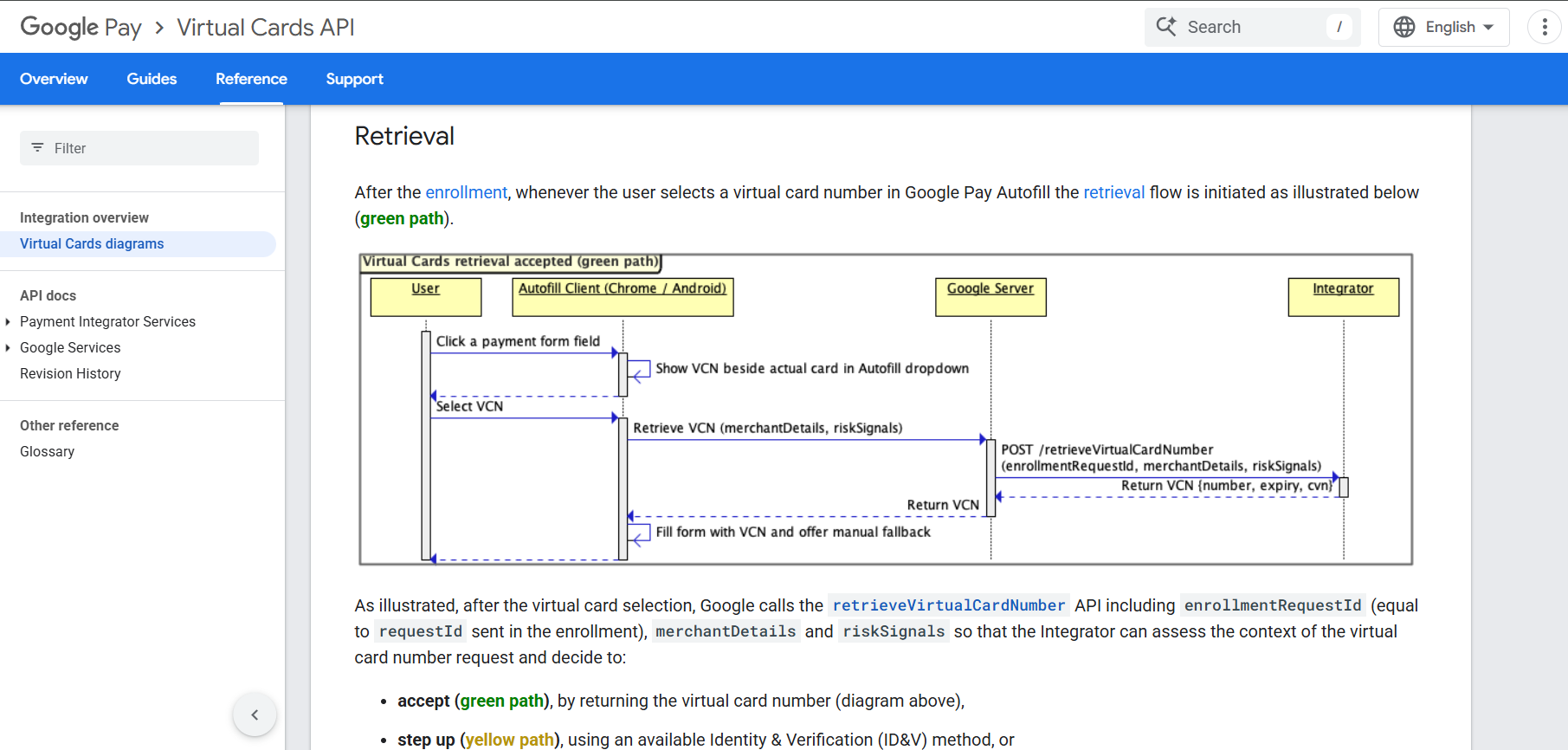
Google's public sequence diagram for the Virtual Cards v1 API — my scope focused heavily on the rigorous execution of the Checkout/Retrieval phase.
Why it matters It maps the external API contract onto the Retrieval surface I owned, the part of the flow where the latency and step-up work sat.
Source: View Google's API docs ↗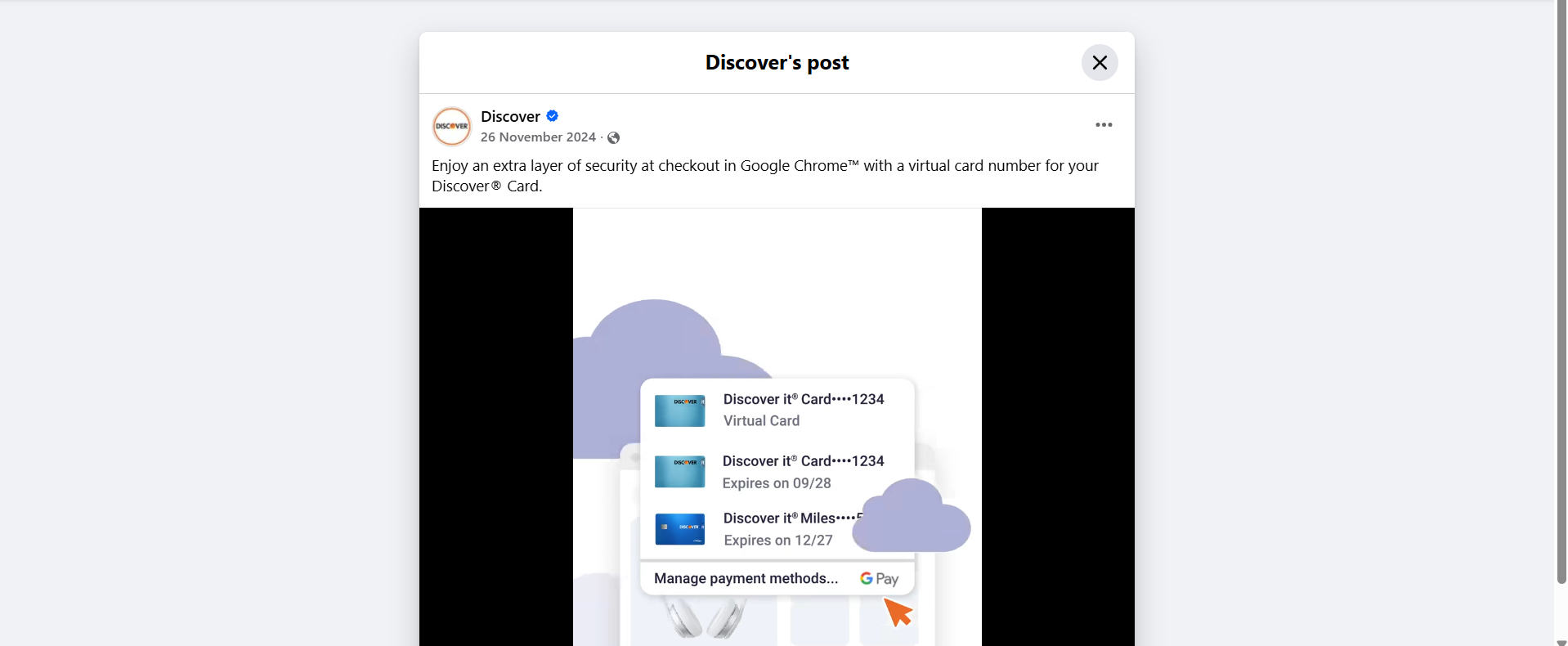
The network's public Facebook post announcing the feature launch, validating the consumer-facing scale of the infrastructure delivered.
Why it matters It is external evidence that the capability went live and reached consumers, not only an internal delivery claim.
Source: View original Facebook post ↗Sources
Where each claim can be checked
- Google Virtual Cards v1: API documentation · the framework this integration implements
- The network's public launch post · consumer-facing launch announcement