
Agentic AI · personal tooling
AI Job Search — Pipeline & Status Automation
Extended an open-source job-search framework with Gmail recommendation-lead detection, repost-dedup hardening, a live application dashboard, and a shared posting-fetch cache — automation layered on a forked base, not authored from scratch.
- role
- Sole developer & end user — directed Claude Code for all implementation
- timeline
- Aug 2026 · ongoing
- status
- Active — used daily for my own job search
My scope
What I owned, what was shared, what I did not touch
- Product direction and every process decision
- Gmail lead detection, repost-dedup hardening, the live dashboard and the shared fetch cache
- Implementation, directed through Claude Code
- Inherited from upstream: the core /apply workflow, the scraper framework and the portal-skill pattern
- Gmail sync's core propose-then-approve mechanism, and the base /rank and /outcome structure
Execution graph · click a stage
From the problem to the outcome
Portal dedup only matched exact URLs or IDs, so a relisted role slipped through.
- An employer relisting an unfilled role under a brand-new ID gets past an ID-only check.
- The fix had to work across portals, not only within a single run.
What was missing
Why this existed
The framework's default output was a static snapshot and application outcomes lived entirely in employer emails I had to notice, reread, and hand-transcribe — with dozens of applications in flight, status updates silently lagged reality.
Portal-level dedup only matched on exact URL or job ID, which missed an employer relisting an unfilled role under a brand-new ID. That wasn't hypothetical: a role I'd already been rejected from was scraped three times under three different LinkedIn IDs, and the surviving copy nearly went out again in a fresh application batch before I caught it (commit 992a944).
What's mine
Inherited, and built on top
- Core /apply workflow: fit evaluation → CV/cover-letter drafting → compile → verify
- Job-scraping CLI framework and the portal-skill pattern
- Gmail sync's core mechanism: propose-then-approve tracker status updates
- Base /rank and /outcome command structure
- Extended Gmail sync to also detect and register job-recommendation digest emails as new scrape leads — the base sync only covered existing applications
- Live, filterable application dashboard — iterated from an early CSV export through a static version to today's live one; job_scraper/ didn't exist in upstream at all
- Cross-portal repost-dedup hardening — two real incidents, two fixes (PR #1, then commit 992a944)
- Shared posting-fetch cache between /rank and /apply
- Security guards enforcing gitignore/permissions/hooks discipline on a public fork
How I worked it
Four moves, one test bed
- 1
Used my own job search as the test bed
Forked the framework in August 2026 to run my active search across the UK, Germany, and Ireland, and used the fork itself as the vehicle to close real gaps I hit using it daily.
- 2
Ran it direct-to-master, deliberately
57 fork-specific commits with no PR-per-change or issue-tracked backlog — a live scraper hitting real job portals needed a tight edit-run-observe loop, and review overhead has no payoff when I'm the only contributor and the only person affected by a regression.
- 3
Closed the repost gap after it actually cost me
The three-LinkedIn-ID incident directly drove a same-company-title check against the entire scrape history, not just the current run's pool — catching the exact failure mode that had already happened once.
- 4
Held data governance to a fixed bar regardless of iteration speed
Every piece of sensitive data — the tracker, scraped-job cache, Gmail sync state, cached research — stayed git-ignored throughout, verified afterward with a full git log --full-history audit rather than just assumed.
Decision records
Calls I made, and why
DECISION 01
Ran direct-to-master, deliberately
57 fork-specific commits shipped this way, and a full git-history audit confirmed nothing sensitive was committed.
DECISION 01
Ran direct-to-master, deliberately
57 fork-specific commits shipped this way, and a full git-history audit confirmed nothing sensitive was committed.
- Problem
- A live scraper against real job portals needs a tight edit, run and observe loop.
- Decision
- Committed straight to master, with no PR-per-change or backlog overhead.
- Why
- This is solo personal tooling. Review overhead has no payoff when I'm the only contributor and the only person a regression affects. OpenCAM, by contrast, has to be defensible to someone else.
- Result
- 57 fork-specific commits shipped this way, and a full git-history audit confirmed nothing sensitive was committed.
Full account from the case study
Contrast this with OpenCAM, a multi-user tool that has to be defensible to someone else. This is solo personal tooling — direct-to-master rapid feedback loops win when I'm the only stakeholder.
DECISION 02
Dedup on company and title, not just ID
The three-ID repost is caught and closed for good, with zero repeats since.
DECISION 02
Dedup on company and title, not just ID
The three-ID repost is caught and closed for good, with zero repeats since.
- Problem
- ID-based checks only catch a repost when the ID matches. An employer relisting an unfilled role under a new ID slips through.
- Decision
- Compare normalised company and title against every existing entry, regardless of when it was scraped.
- Why
- ID checks structurally can't catch a relisting under a new ID.
- Result
- The three-ID repost is caught and closed for good, with zero repeats since.
Full account from the case study
ID-based checks only catch a repost when the ID matches. Comparing normalized company + title against every existing entry, regardless of prior scrape date, catches the case ID checks structurally can't (commit 992a944).
DECISION 03
Cache once, reuse everywhere
The common rank-then-apply path costs one fetch instead of two.
DECISION 03
Cache once, reuse everywhere
The common rank-then-apply path costs one fetch instead of two.
- Problem
- /rank and /apply were each independently re-fetching the same posting.
- Decision
- A shared, normalised-filename cache.
- Result
- The common rank-then-apply path costs one fetch instead of two.
Full account from the case study
/rank and /apply were each independently re-fetching the same posting. A shared, normalized-filename cache means the common rank-then-apply path costs one fetch instead of two.
technical evidence · repost and sync
The repost that nearly got reapplied to
One rejected role, three LinkedIn IDs, one near-miss. It was caught by comparing company and title against the whole history.
- 01Rejected role scrapedLinkedIn ID A
- 02Scraped againLinkedIn ID B
- 03Scraped a third timeLinkedIn ID C
- 04Nearly reapplied tothe surviving copy, in a new batch
- 05Caught by company + titlechecked against the whole scrape history
Gmail sync, one representative run
Application outcomes arrive as employer emails. One run replaced rereading the inbox by hand.
- 0111 threads in the windowone pass
- 027 outcome updates resolvedpropose-then-approve, inherited mechanism
- 032 new leads surfacedjob-recommendation digests registered as scrape leads
What changed
What it delivered
- The repost-hardening fix closes a failure mode that had already cost one wasted application before it shipped — zero repeats since.
- One representative Gmail-sync run resolved 7 outcome updates and surfaced 2 new leads from an 11-thread window in a single pass, replacing unbounded manual inbox rereading.
proof
The claim, traced to the outcome
Inside the build
Artefacts from the build and the launch
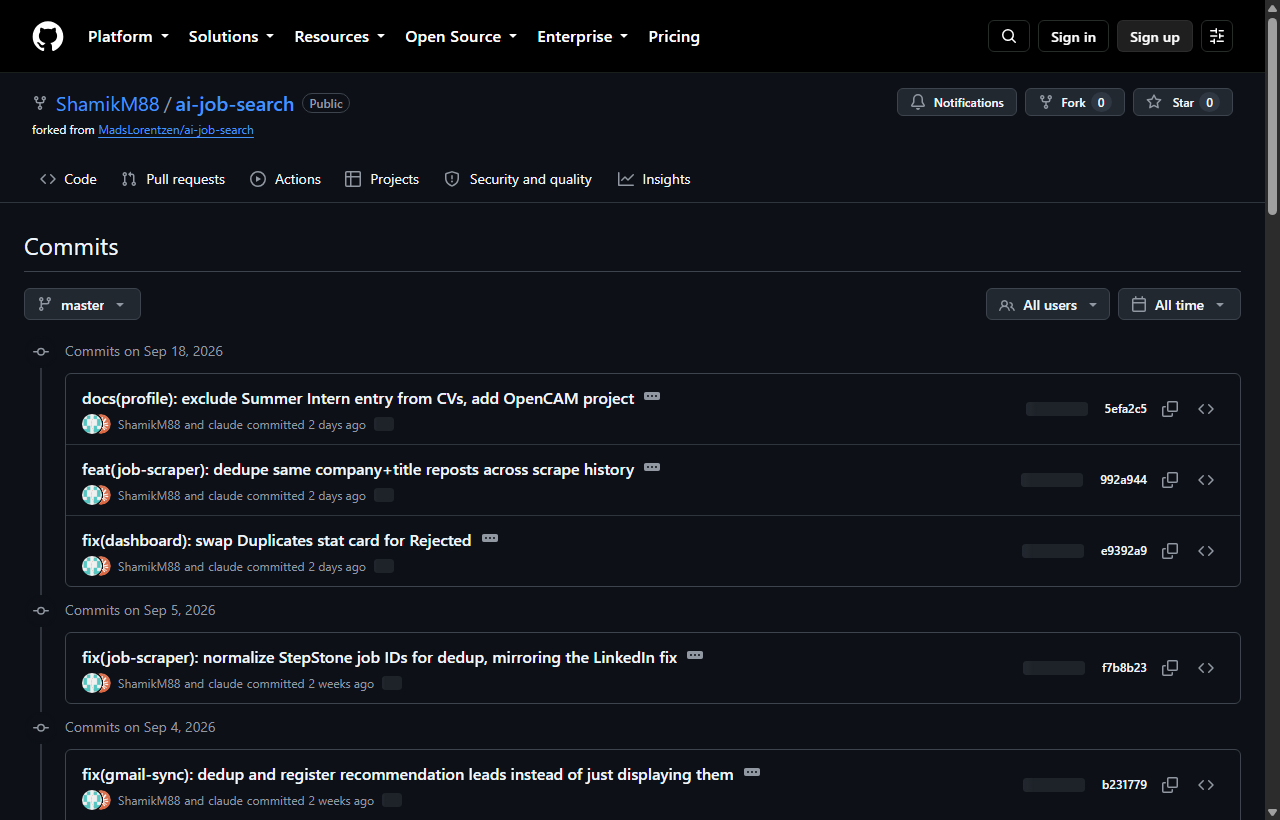
57 fork-specific commits on GitHub, diverged from the upstream MadsLorentzen/ai-job-search base.
Why it matters It is the audit trail for the direct-to-master decision: every change is visible in the history.
Source: the ai-job-search fork ↗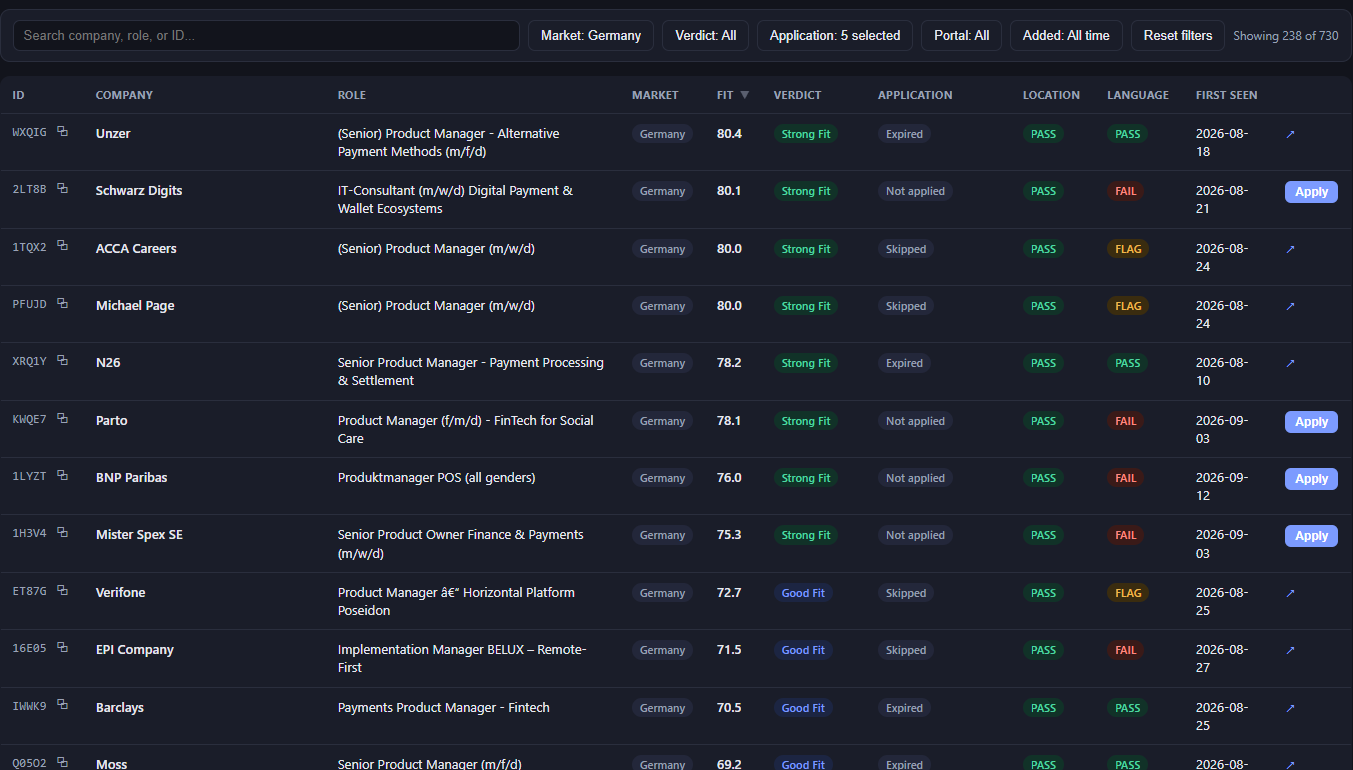
The live dashboard, filtered to postings not yet applied to — fit scoring, gates, and dedup status per row.
Why it matters It shows the operational use: fit scoring, gates and dedup status per row, for postings not yet applied to.
Source: the ai-job-search fork ↗Sources
Where each claim can be checked
- ShamikM88/ai-job-search: the fork · my commits on top of the base
- MadsLorentzen/ai-job-search: the upstream base · the framework this extends